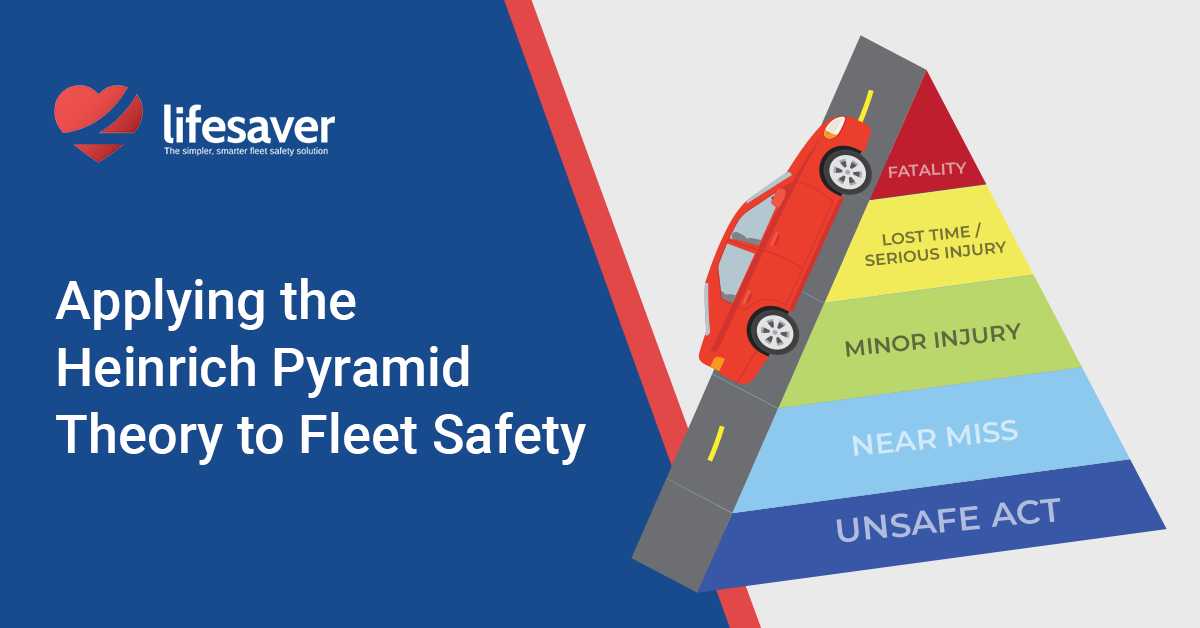
What is Heinrich’s Pyramid of Accident Severity?
Developed in the 1930s by an insurance professional named Herbert Heinrich who studied about 75,000 accidents, his theory has become a foundational concept in occupational health and safety. Heinrich found that there is a direct correction between different types of workplace incidents: near-misses, minor injuries, and major injuries or fatalities.
His theory asserts that for every major injury, there are 29 minor injuries and 300 near-misses. By addressing the base of the pyramid (near-misses and minor injuries), organizations can reduce the occurrence of major injuries and fatalities.
The practical application of the Heinrich Safety Pyramid in incident management involves focusing on the base of the pyramid (near-misses and minor injuries) to prevent more severe incidents higher up.

Heinrich Pyramid’s Implications for Fleets
While the specific ratios in the Heinrich pyramid above are not scientifically recognized, most safety professionals agree that these learnings from his study are best practices that should be followed:
-
By identifying, reporting, and addressing these lower-tier incidents, organizations can reduce the occurrence of major injuries and fatalities.
-
This approach encourages a proactive safety culture, where all incidents are seen as opportunities for improvement rather than just outcomes to be avoided.
To that end, here are some best practices for identifying, reporting, and addressing these lower-tier incidents:
-
Encourage drivers and fleet managers to report near-misses and minor incidents. This helps identify potential hazards before they lead to serious accidents.
-
Analyze incident reports to identify patterns and common causes of near-misses and minor accidents. This data can inform targeted interventions.
-
Education: Provide regular safety training for drivers, focusing on the prevention of near-misses and minor incidents. Emphasize safe driving practices and the importance of reporting all incidents.
-
Inspections: Regularly inspect and maintain vehicles to prevent mechanical failures that could lead to accidents. Addressing minor issues promptly can prevent them from escalating into major problems.
-
Culture: Foster a culture of safety within the fleet. Encourage open communication about safety concerns and recognize drivers who adhere to safety protocols.
How Can My Company Lower the Frequency of Hazards (Unsafe Acts and Unsafe Conditions)?
Applying the Heinrich Pyramid of safety to fleets, if an employer can influence its drivers to lessen their frequency of unsafe driving behaviors (the Hazards layer in the image above) such as speeding, harsh acceleration, braking, and cornering, the employer should see a correlating reduction in all of the other layers of the pyramid up to and including the serious injuries and fatalities from driving incidents.
Of course, there are many ways that an employer can lower the frequency of these unsafe acts through driver monitoring and coaching, in-cab warnings and ADAS. As we have discussed in a previous blog, these techniques and technologies have their pros and cons which you can read about here.
Driver monitoring and coaching. While technology can help improve driver behavior, the task is much greater if the offending behaviors have to be reported back to management and drivers. In these cases, a continuous program of effective feedback to drivers must be developed. This represents a major commitment of time and dollars and a challenge that the program may become stale over time.
Dash cams. Systems that can provide in-cab warnings to the drivers can also lower the frequency of unsafe acts. These are more effective if the dashcam is dual-facing, but unfortunately not every organization is able to deploy the dual-facing camera due to privacy issues, or union and/or employee resistance.
ADAS. The most impactful type of technology automatically restricts unsafe behavior from happening in the first place.
-
Examples are speed governors and to an extent, automated braking and lane departure systems
-
One of the leading causes of auto crashes comes from the distraction caused by cell phone misuse. Technology solutions are available that restrict the driver from even engaging in these risky behaviors in the first place.
Technology can shorten the “long road to driver behavior improvement” by moving the focus from the identification of risky behaviors to actually making the risky behavior unavailable to the driver. To a degree, this eliminates the focus on identification if the unsafe acts can no longer occur. By reducing the frequency of unsafe acts in the bottom tier of Heinrich’s Pyramid, your company will move the needle on all the other tiers, including major injuries and fatalities.