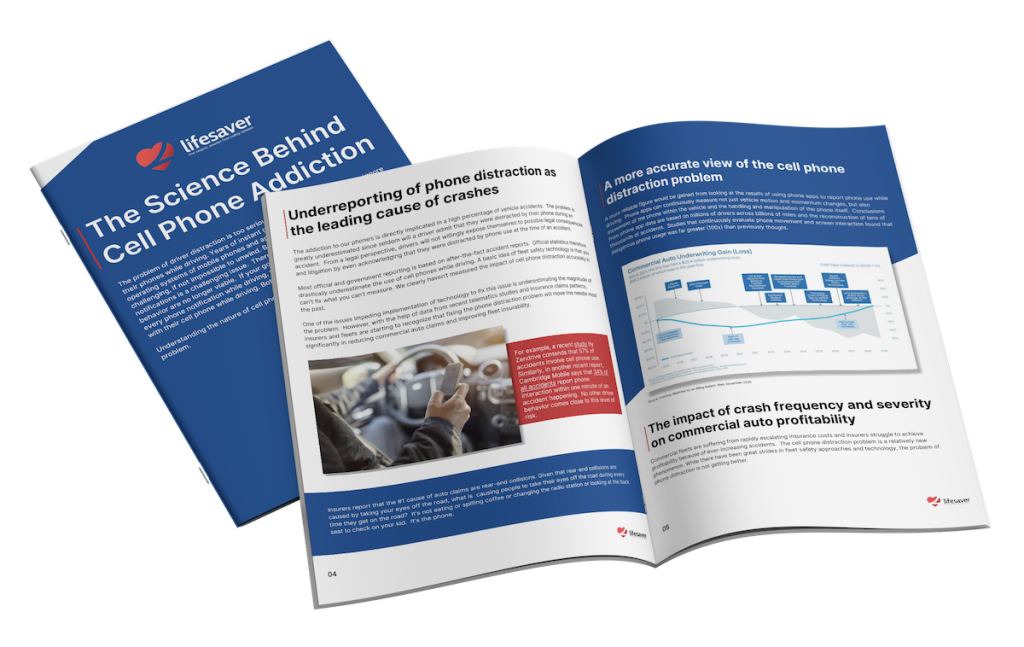
For years, fleets have tried to solve distracted driving the same way: policies, training, and a belief that a strong culture of trust will keep drivers off their phones.
It’s a well-intentioned approach. And it doesn’t work.
The reason is simple but uncomfortable: cell phone distracted driving is not a cultural issue — it’s an addiction issue. Phones are engineered to hijack attention, and no amount of trust, coaching, or good intentions can overcome that reality.
Fleets that successfully eliminate cell phone induced driver distraction tend to go through the same five stages. Understanding these stages can help organizations move faster and avoid the liability exposure that comes from relying on solutions that were never designed to work.

Step 1: “Our Drivers Know Better”
Most fleets start here. Leaders believe their drivers are professionals who understand the risks. They roll out cell phone use policies, conduct training sessions, and emphasize personal responsibility. The assumption is that if drivers know the rules and feel trusted, they will comply.
But data consistently shows otherwise. Even the most experienced, well-trained drivers still reach for their phones. Not because they don’t care, but because the behavior is automatic and deeply conditioned. Expecting drivers to simply resist is like asking them not to react when their phone buzzes ignores how the brain actually works.
Step 2: “Let’s Build a Culture of Trust”
When training alone doesn’t solve the problem, fleets often double down on culture.
The messaging becomes: We trust you to do the right thing. The hope is that mutual respect and accountability will curb phone use behind the wheel.
Unfortunately, this is where risk quietly increases. Phones are intentionally designed to bypass conscious decision-making. Dopamine-driven feedback loops trigger instinctive behavior long before logic or policy kicks in. A culture of trust does not neutralize an addiction — and worse, it creates the illusion that the risk is being managed when it isn’t.
From a liability standpoint, this is dangerous. Trust is not a defense.
Step 3: “We’ll Monitor and Coach the Behavior”
At this stage, fleets introduce dash cams, telematics, and coaching programs. The goal is visibility: identify phone use, correct it, and move on. This is progress, but it’s still incomplete.
Monitoring and coaching are reactive. By the time phone distraction is detected, the dangerous behavior has already occurred. Coaching may reduce some incidents, but addiction-driven behavior resurfaces — especially under stress, boredom, or urgency.
Fleets begin to realize that documenting distraction without preventing it does little to reduce crash risk long-term.
Step 4: “The Liability Reality Check”
This is the turning point. As claims rise and litigation becomes more aggressive, fleets recognize a hard truth: knowing distracted driving with cell phones exists and failing to stop it creates massive liability exposure.
Dash cam footage showing repeated phone-use events. Coaching records without meaningful behavior change. Policies that rely on trust rather than enforcement. All of it raises the same question in court or during underwriting:
If you knew this was happening, why didn’t you stop it?
At this stage, fleets realize that observation without prevention is not enough.
Step 5: “We Remove the Temptation Entirely”
This is where real change happens. Instead of asking drivers to fight an addiction, fleets eliminate the trigger altogether. Phone use is restricted while driving. Screens don’t light up. Apps can’t be opened. Notifications never appear.
This is the only approach aligned with behavioral science, and the only one proven to meaningfully reduce phone-related crashes.
LifeSaver Mobile makes this possible. By blocking unauthorized phone use while vehicles are in motion, LifeSaver Mobile removes distraction at the source. Drivers aren’t tempted. They aren’t distracted. And fleets aren’t left hoping that trust or coaching will succeed where addiction is designed to win.
The Bottom Line
Culture matters. Training matters. Visibility matters. But none of them can overcome an addiction engineered into every smartphone.
Fleets that rely on trust alone don’t eliminate phone distraction — they inherit the liability. Fleets that rely on monitoring alone document risk without stopping it.
The only true solution is prevention. If your fleet hasn’t reached Stage 5 yet, the question isn’t if you need to, it’s how long you can afford to wait. LifeSaver Mobile’s distracted driving solution exists to help fleets get there now.