Commercial auto has lost money every year since 2013, without interruption through the entire dashcam era. The commercial auto segment produced net underwriting losses every year from 2013 through 2023, making it the weakest property/casualty line for over a decade, with a combined ratio of 109.2 in 2023.
The one exception, 2019 to 2021, was not a safety win. The brief respite was due to the sharp decline in driving activity during COVID-19, when the segment generated a 99 combined ratio in 2021. It had nothing to do with technology or coaching.
On distracted driving specifically, the trend is moving in the wrong direction. Distracted driving violations are up 57% across all drivers compared to 2022, while miles driven increased only 2%, confirming that behavior, not exposure, is driving risk.
Distracted driving violations specifically increased 50% from 2023 to 2024 alone.
Commercial auto premiums have now increased for 54 consecutive quarters, a direct result of lowered underwriting capacity and increased claims.
The timing is particularly notable: AI dashcams went mainstream in fleets roughly around 2015–2016. The combined ratio got worse, not better, in the years immediately following.
The article’s core argument holds up: observation without prevention has not moved the needle.
Fleet safety vendors love to talk about cameras.
More cameras. Better AI. Smarter detection. Real-time alerts. Driver coaching.
And yet commercial auto claims continue to rise.
Why?
Because the fleet industry keeps trying to solve phone addiction with observation tools instead of prevention technology.
Dashcams are useful for documenting incidents. They can provide visibility into driver behavior. They may even help after a collision occurs.
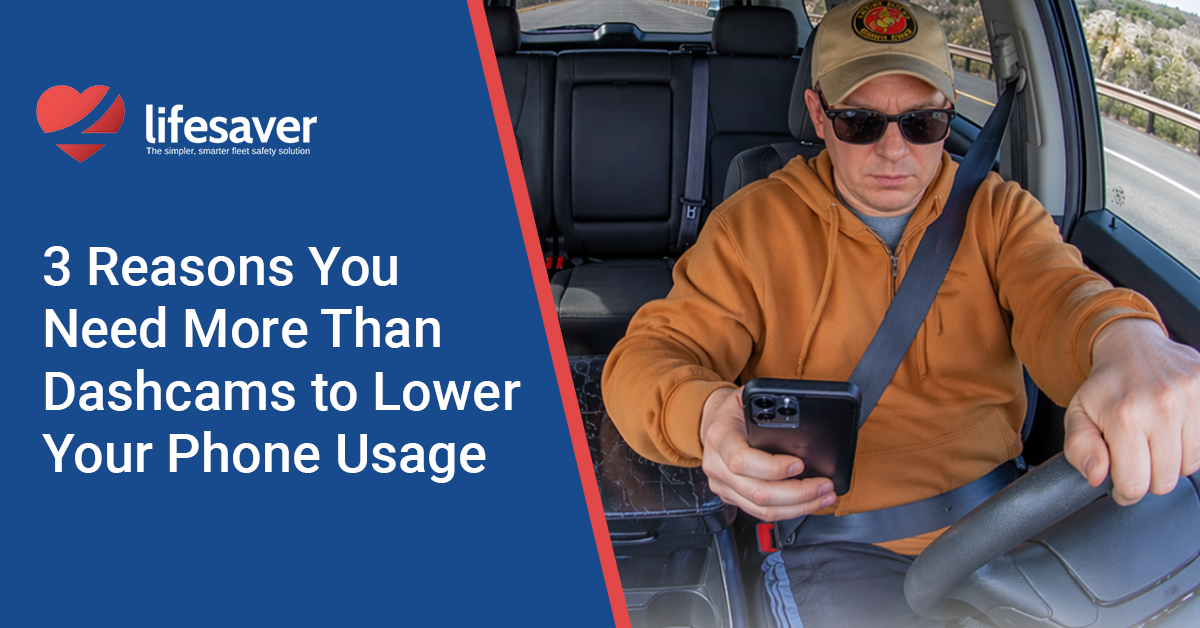
But if your strategy for stopping distracted driving begins and ends with cameras, you are leaving your fleet exposed.
Here are three reasons why.
1. Dashcams Only See What’s Inside the Frame
Every camera has a limited field of view.
That means anything happening outside the lens simply doesn’t exist to the system.
A driver holding a phone low in their lap.
A quick glance below the dashboard.
A thumb tapping a notification at a stoplight.
A screen lighting up just outside the camera angle.
None of it gets reliably captured.
This is one of the biggest flaws in the entire “AI dashcam” conversation. Fleets are being sold the idea that cameras create complete visibility into distracted driving behavior when, in reality, they only provide partial visibility.
And when it comes to phone distraction, partial visibility is not protection.
The truth is simple: cameras cannot monitor what they cannot see.
2. We Are Scientifically Addicted to Our Cell Phones
This is the part the dashcam industry refuses to talk about.
Phone distraction is not just a behavioral issue. It is an addiction issue.
Smartphones and apps are intentionally engineered to hijack attention using dopamine-driven reward systems. Every vibration, buzz, banner, and notification creates a neurological impulse to respond.
Drivers are not making fully rational decisions in those moments. The response is conditioned and automatic.
That means no amount of:
- Verbal alerts
- Coaching sessions
- Driver culture
- Trust-based policies
- Camera warnings
can reliably stop the behavior.
You cannot coach someone out of a neurological reward loop designed by trillion-dollar technology companies.
The fleet industry continues treating distracted driving like a compliance problem when it is actually a compulsive behavior problem.
This is why fleets continue seeing repeated phone-related events even after deploying cameras and conducting coaching programs.
The temptation never goes away.
And as long as the temptation exists, distraction will continue.
For a deeper dive into the science behind cell phone addiction, check out LifeSaver Mobile’s ebook here: The Science Behind Cell Phone Addiction.
3. Dashcam AI Cannot Reliably Identify Cell Phones vs. Other Objects
Despite the marketing language, cameras are not actually very good at identifying phones.
Most systems infer distraction based on:
- Eye direction
- Head movement
- Hand positioning
- Facial orientation
But none of those things definitively prove phone use.
Drivers can look down for many reasons.
Drivers can hold objects that are not phones.
Drivers can manipulate phones outside camera visibility entirely.
And even when a phone is visible, many systems still struggle with accuracy, false positives, and inconsistent detection.
The result?
Fleets end up flooded with questionable events, inconsistent coaching data, and an overwhelming number of alerts that drivers eventually tune out.
More importantly, fleets develop a false sense of security, believing they have solved distracted driving because a camera system exists.
They haven’t.
They’ve simply documented pieces of the problem.
Dashcams Don’t Prevent Phone Usage. LifeSaver Mobile Does.
This is the fundamental distinction the industry needs to understand.
Dashcams observe distraction.
Dashcams record distraction.
Dashcams comment on distraction after it begins.
LifeSaver Mobile prevents distraction before it happens.
By blocking unauthorized phone use while driving, LifeSaver Mobile removes the temptation itself:
- No app access
- No screen interaction
- No notification response
- No opportunity for distraction
This is the only approach aligned with the science of addiction.
And in today’s litigation and insurance environment, prevention matters more than observation.
Because when a crash occurs, the question is no longer:
“Did you know distracted driving was happening?”
The question is:
“If you knew it was happening, why didn’t you stop it?”
That is the gap camera systems cannot close.
LifeSaver Mobile can.
Conclusion
None of this means dashcams are without value. They remain essential. When a collision occurs, camera footage is often the difference between a driver being exonerated and a fleet absorbing a nuclear verdict. That protection is real, and no serious safety strategy should operate without it.
But exoneration is not prevention.
The data is clear: commercial auto has produced underwriting losses every year since 2013, through the entire dashcam adoption era. A $5 billion net loss in 2023. Fifty-four consecutive quarters of premium increases. Distracted driving violations up 57% since 2022. Cameras documented all of it. They did not stop any of it.
The reason is simple: phone distraction is not a compliance problem that observation can solve. It is a compulsive behavior problem. You cannot coach someone out of a neurological reward loop, and you cannot film your way past an addiction.
The only interventions that work are engineered ones. Speed limiters do not ask drivers to choose wisely. They remove the choice. LifeSaver Mobile works the same way, blocking phone use the moment a vehicle moves. The distraction is not managed. It is eliminated.
Cameras protect drivers after something goes wrong. Engineered prevention protects the fleet before it does.
Fleets need both, but after a decade of rising losses, it is clear that cameras alone will never be enough.